
Yes, Outlier AI is legit. It is a real work platform run by Scale AI, a US company that sells AI training data to AI companies, and it pays active contributors every week.
Short answer:
- Legit: yes. Outlier is run by Scale AI, and it pays active contributors every Tuesday.
- Main risks: Outlier can close your account without naming a reason, it can hold the pay you earned before the closure, and your task queue can stay empty for weeks or months.
- Try it if: you have a skill that a current listing asks for, and you can go weeks without work.
- Skip it if: you need steady weekly income.
Outlier pays subject-matter experts to improve AI answers. In November 2026, Outlier said it had paid them more than $500 million in total. To see what it takes to start working there, I applied to one of its listings and took the written step and the AI interview myself.
Is Outlier legit as a company?
Yes. When you sign up, your contract is with Scale AI, Inc. and its affiliate Smart Ecosystem Inc., which does business as Outlier AI.
The tasks on Outlier come from Scale AI’s customers, which are AI companies. So a project lasts only as long as the customer needs it, even if your account is in good standing.
Outlier AI jobs and what they pay
On hourly projects, you rate, compare or create content for AI: you rank AI answers, images and videos, chat with an AI and say what went wrong, or film video clips. You are paid for the time on the task timer. On expert projects, you design hard problems that AI models fail, and you are paid per task.
The list below shows the kinds of work on Outlier and the most that each listing paid when I checked in November 2026. Items 1 to 5 were on Outlier’s opportunities board, and the two expert projects (items 6 and 7) had their own Outlier pages:
- AI Image and Video Judge: up to $18 an hour, open in 33 countries, including the US, the UK, India and the Philippines. You hold a live conversation in English with AI voice models and rank them, and you compare pairs of AI images and videos to choose the one that better follows the prompt. You also spot these flaws: distorted anatomy, flickering or unnatural motion, text errors, and audio that does not match the video.
- English-Speaking AI Image and Video Evaluator: up to $7 an hour, for the Philippines only. The task is the same as in the listing above. The AI Image and Video Judge listing is open in the Philippines too, so check which of the two listings your dashboard offers and at what rate.
- Native German Freelance Writer: up to $29 an hour, and you must live in Germany. You chat with an AI in German, rate each conversation, and explain what went wrong: wrong facts, ignored instructions or German that sounds unnatural. The Korean version pays up to $31 an hour, and only people based in Korea qualify.
- Video Production Expert: up to $50 an hour, in the US, the UK, Canada, Australia, New Zealand, Mexico, Argentina and Puerto Rico. You film original clips of 10 to 30 seconds from a brief, for example one scene from several angles at once. You need a camera or phone that records 1080p at 30 frames per second, and a tripod: “Handheld footage won’t pass.”
- General Inbound (Coding) and General Inbound (Generalist): up to $30 and up to $18 an hour, in the same 8 countries. These are sign-up lists, not jobs. You submit your interest, and Outlier contacts you only when a project fits your skills.
- Terminal-Bench: up to $1,800 per task. On this expert project, you design difficult tasks that an AI agent must solve in a computer terminal, and you build the verifier, the automated script that checks whether the agent succeeded. An example task: “Find and fix 26 hidden layout shifts across a Next.js codebase”. Outlier lists a STEM degree or equivalent professional experience, and “6+ years of real-world experience”, as ideal qualifications, not strict requirements. Tasks “typically take 6 to 7 hours”, and you are paid only for a task that “stumps frontier AI models”. The rate you are offered can be lower: one contributor was offered Terminal-Bench at $700 per task.
- Operations Expert: up to $360 per task. It asks for a master’s degree, and ideally 8 to 10 or more years of back-office work. You write a hard, realistic problem, its verified solution and a checker script, then test it on leading AI models to confirm that they struggle with it or fail.
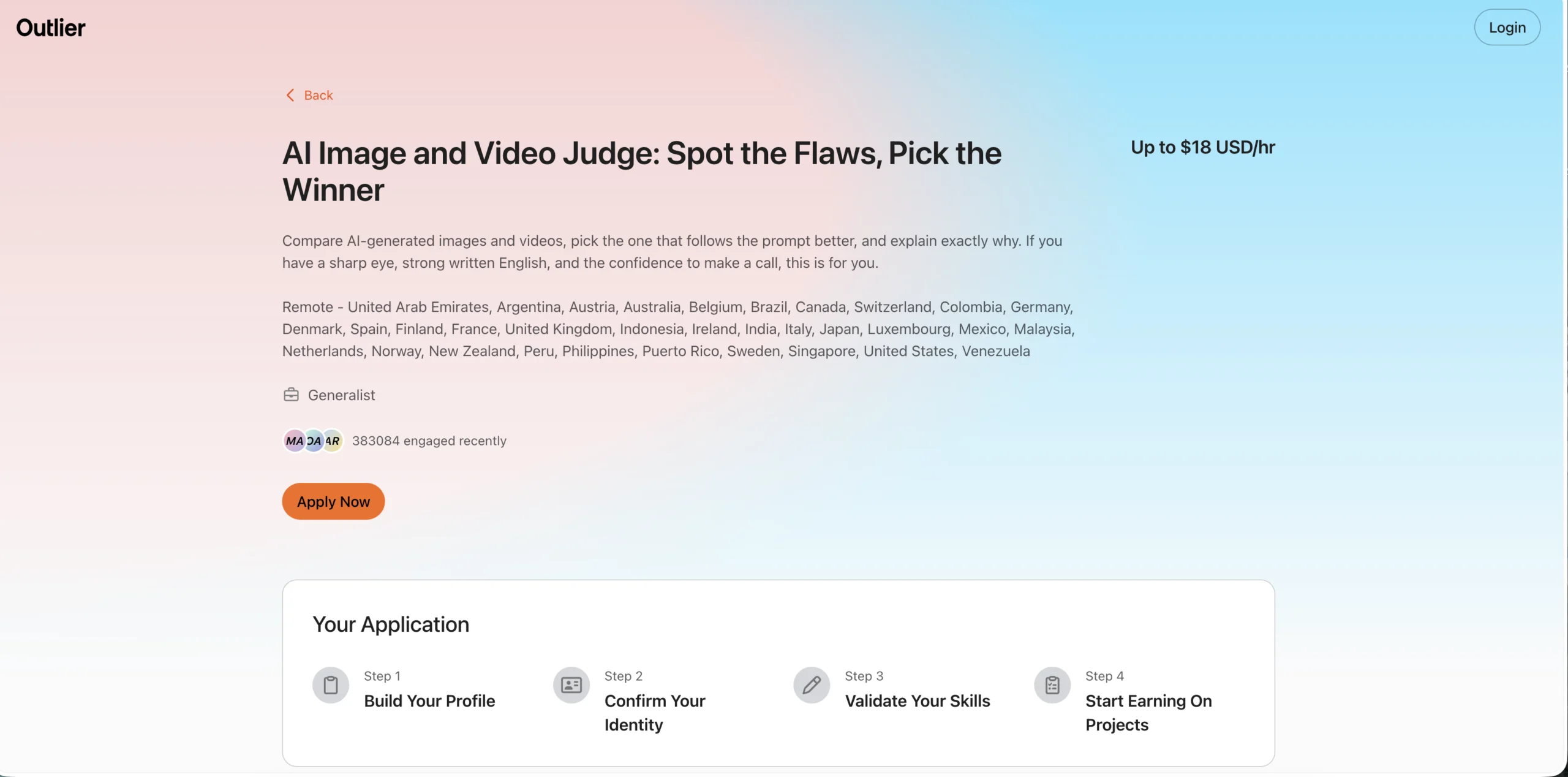
Every “up to” rate is the most that the listing pays, not what you will earn. Outlier shows you the rate of each project before you start it.
How and when Outlier pays
Outlier pays once a week, and it pays you as a contractor, not as an employee. These are the facts you need about payday, payment methods, fees, bonuses and tax:
- Payday: every Tuesday, for work done from the previous Tuesday through Monday. In the US, the money usually arrives late Tuesday night or Wednesday morning.
- Payment method: PayPal or AirTM, an online wallet and payment service. US contributors can also be paid by ACH, a direct transfer to a US bank account.
- Fees: Outlier lists no payout fee.
- Bonuses: Missions are extra rewards on top of your rate. When I checked in November 2026, Outlier’s expert project pages said that, based on Outlier’s payments in the previous six months, Missions added 7.5% to contributors’ earnings on average.
- Tax: you are an independent contractor, so Outlier withholds no income tax or Social Security. US contributors receive a 1099, the US tax form for contractor income.
What workers say went well on Outlier, and what they earned
These workers reported on Reddit what went well for them on Outlier and what Outlier paid them. What they earned differs widely, because Outlier sets its rates by expertise, project and location:
- A worker in the UK with a marketing and writing background was paid for 33 hours in their first week on Aether, a generalist project on Outlier, where they compared images and checked text-to-speech. The rate was $18.70 an hour, “basically the minimum wage here in the UK”. Where they live, Outlier allowed them to log up to 70 hours a week (March 2026).
- A student on Aether earned about $1,200 in their first two full weeks, after waiting months for their account to be verified. The student called the work “insanely boring and unfulfilling” but valued the flexible hours (December 2025).
- A generalist and college student in Mexico reports working 20 to 30 hours a week for about $200 a week, which is enough to live on in their hometown. They sometimes wait 1 to 2 days for the next task (June 2026).
- A generalist in Sweden reports at least $28 an hour on every generalist project they worked on, and $70 an hour on a voice project (November 2026).
- A STEM contributor reports “60$+ per hour” (September 2026).
In these reports, the rates go from about $7 to $10 an hour in Mexico to $18.70 in the UK, $28 in Sweden, $60 or more on STEM work and $70 on a voice project.
Is Outlier AI a scam?
No, Outlier AI is not a scam. It pays contributors every week through PayPal, AirTM or ACH, and it sends US contributors a 1099. But workers do lose pay, hours and accounts, and most of these problems are allowed under Outlier’s own rules, which are listed after the reports below.
What workers say went wrong
In these five reports, two workers lost pay when Outlier closed their accounts, and three saw their rate drop, one of them also with fewer hours on the earnings page than they worked:
- A worker on two projects logged 172 hours over about two months, kept an average rating of about 4.5 out of 5, and earned over $7,000. Then Outlier deactivated (closed) the account without naming a reason, and the worker could no longer open any Outlier page, including the earnings page. In an update 14 days after the post, the worker reported that about $400 for the last working day was still unpaid (August 2026).
- An Aether worker with 4 months on the project and more than 500 ratings was banned with a generic email that cited Outlier’s Community Guidelines. About 60 hours of work at $25 an hour, about $1,500, was unpaid when they posted (July 2026).
- An Aether worker’s rate dropped in one evening from $13.75 to $5.55 an hour. That day’s 2 hours 17 minutes of work showed as 1 hour 11 minutes on the earnings page. At least 8 commenters reported the same problems (May 2026).
- A generalist was paid $20 to $25 an hour in 2025, plus weekly Missions of up to $200. When they posted, Outlier was offering them projects at $17 an hour, for tasks that other platforms pay $20 an hour or more for (September 2026).
- A STEM reviewer in Taiwan was paid $50 an hour until what looked like a location policy change in October 2025. Since then, Outlier has offered them only Aether, at $9.75 an hour, and they moved to another platform that pays $55 an hour (September 2026).
Outlier’s rules on pay, tasks, accounts, your data and legal claims
Outlier’s Terms of Use, Community Guidelines, FAQ and Privacy Policy explain most of the problems above. These are the rules that matter most. The last two points are about your legal claims: a settlement for California workers and the arbitration clause.
- Only timer time is paid. On hourly projects, Outlier pays only for the time on the task timer. Read the project guidelines with the timer off: a new Aether contributor read them for slightly over two hours with the timer running and was deactivated on the first day. General screening is unpaid, and some projects pay a lower rate during onboarding.
- Outside help and other tabs. Under Outlier’s Community Guidelines, you must do tasks without help from other people, bots, scripts or outside materials and tools, unless a task requires them. On Aether, you also run Hubstaff, a time-tracking app, and share your screen, and Terminal-Bench has also asked for screen sharing. A worker who opened another tab for a translation was deactivated, and the Reddit account that replies for Outlier said the worker was “engaging in dishonest behavior while tasking”.
- Pay can be held or withheld. Under Outlier’s Terms of Use (the Terms), Outlier can “delay or suspend payment during any investigation”. After a violation “in the Company’s sole determination”, which means that Outlier alone decides whether you broke a rule, it can withhold “some or all amounts accrued”. When an account closes, the Terms say Outlier pays a final payment for tasks already completed. Outlier support told one deactivated worker that eligible earnings are paid within 2 weeks, and that no payment after 2 weeks means the earnings were withheld.
- Account closure without notice. Outlier can close your account or remove task listings “at any time, immediately without prior notice for any reason”. After that, you cannot see any information in your account, including your earnings.
- No guaranteed tasks. Outlier’s FAQ says that project lengths “vary depending on the needs of our customers”. When no project needs you, your queue is empty: your dashboard has no tasks for you, and this can last for months. On Reddit, a contributor with over two years on Outlier reported a longest empty queue of 8 months.
- Primary Location. Outlier can ask you to verify your location with a government-issued ID, and the place you verify becomes your Primary Location. If you move to another country or to another US state, you must update your Primary Location, and Outlier may ask for a new ID. You may not use a VPN to hide your location.
- ID checks and face data. When you sign up “and at regular intervals thereafter”, Outlier, Persona (the identity-verification company it uses) and other verification providers can collect selfies, video or audio recordings and images of your government-issued ID, and can produce measurements of your face from them. Outlier says it does not sell this data, and it keeps it for up to two years after your last activity. To ask for it to be deleted, email pr*****@*****er.ai. In some cases, Outlier offers another way to verify your identity. Outlier may also ask for your Social Security number as proof of identity, and US contributors give a taxpayer ID for the 1099.
- A settlement for California workers. Scale AI agreed to a $12.5 million settlement in McKinney v. Scale AI, a California class action about misclassification (treating workers as contractors when the law treats them as employees) and unpaid wages. The court has granted final approval. If you lived in California and worked on Outlier or Remotasks, another Scale AI platform, from December 10, 2020 to February 28, 2026, you are in the class: there is no claim form, and payments are based on the weeks you worked.
- Arbitration in the US, with an opt-out. If you live in the US, then under the Terms, your claims against Outlier go to individual arbitration, a private process in which an arbitrator, not a judge or jury, decides the dispute. You also cannot join a class action like the McKinney case. To opt out, email le**********@***le.com within 30 days of accepting the Terms, from the email address on your Outlier account. In the email, say that you opt out of the Arbitration Agreement, and give your full name and the city you live in (Section 10(e) of the Terms).
How Outlier screens you before you get paid work
General onboarding usually takes 30 to 90 minutes: you build a profile, choose your skills, verify your ID and complete skill screenings. Each project then has its own onboarding, with assessment tasks and guidelines.
The screening steps depend on the listing, and some listings use recorded video answers or an AI interviewer. The listing I applied to had a written step and then an AI interview by voice and video. If your listing has an AI interview, read my article on the Outlier AI video interview before yours: it shows each question from my interview, how I answered it and what a stronger answer would look like.
Outlier says selection is competitive, and a rejection can arrive seconds after you finish an assessment. A rejection is not always final: one applicant’s failed assessment was reviewed by a person later and reopened, and the applicant passed on the second try.
How to tell a real Outlier message from a fake
To work on Outlier, you give it your government ID, selfies, video and your payment details. Scammers pose as Outlier, or as employers and recruiters, to get the same things from you, or to use your identity for an Outlier account that they control. Real Outlier recruiters also contact people on LinkedIn, so a message that you did not expect can be real or fake. Before you upload your ID, send a document or follow onboarding steps from a message, check that the request comes from Outlier.
Outlier says it uses these addresses:
- Website: outlier.ai and app.outlier.ai. On app.outlier.ai, you create your account, apply to listings, verify your ID, take the interview and do the work. Outlier warns that fake websites can look like outlier.ai.
- Email from Outlier: Outlier’s Aether FAQ says its emails come only from addresses that end in @outlier.ai.
- Sign-up questions: on********@*****er.ai
- Support: the support link in your Outlier dashboard, the home page of your account
- If your account may have been misused or broken into: write to se******@********er.com.
A fake email can copy a real sender address, so an @outlier.ai address alone does not prove that an email is real. Treat a message as fake if it:
- asks you to pay anything to start, because Outlier says it never charges for onboarding, and none of the steps Outlier publishes asks you to pay
- asks for your Outlier password or your two-factor verification codes, because Outlier says its staff never ask for your password
- comes from an address that is not on the list above
- asks you to do a step, send a document or follow onboarding instructions that are not on your Outlier dashboard
- offers you money to complete an ID check for an account that someone else will use (one stranger offered $20 to $40 for one ID check)
- is a job interview for another company that takes you through Outlier’s ID check and assessments (one job seeker who “interviewed” with someone posing as a therapy office then found an Outlier account already set up under a stranger’s email and phone number)
- offers to buy or rent your Outlier account (one offer was “40% of the profits”)
Renting, selling or verifying an account for someone else breaks Outlier’s one-account rule. Outlier can then close the account, and a stranger has your ID.
If you are not sure about a message, do not click its links. Open app.outlier.ai yourself, sign in, and check whether the listing or the step is on your dashboard. You can also ask Outlier Support from your dashboard before you share any personal details. Create your Outlier account yourself, and never complete an ID check on an account that someone else set up.
Outlier’s review scores on Trustpilot, Indeed and BBB
When I checked the three review sites in November 2026, workers on Indeed rated job security lowest, and the BBB graded how Outlier answers complaints. Outlier had these scores:
- Trustpilot: 3.9 out of 5 from 5,786 reviews. Of those, 61% give 5 stars and 21% give 1 star. Outlier asks its users to write reviews there, so part of the score comes from reviews that Outlier asked for. Outlier replied to 47% of the negative reviews.
- Indeed: 2.5 out of 5 from 799 worker reviews. Workers give job security the lowest score, 1.8. Management gets 2.0 and pay 2.4, and work-life balance gets the highest score, 3.0.
- BBB: the Better Business Bureau, a nonprofit that grades how businesses handle complaints, rates Outlier F for not responding to 8 complaints.
Indeed’s scores say more about Outlier as a place to work than the Trustpilot average, because Indeed collects reviews from workers and scores each part of the job separately. The low score for job security matches the empty queues and closed accounts in the reports above, and the higher score for work-life balance matches the flexible hours that workers praise.
Who should try Outlier and who should skip it
Whether Outlier is worth your time depends on your skills, on where you live and on how much you depend on steady pay.
Outlier is worth a try if both of these points are true for you:
- you have skills that a current listing asks for: a language you speak natively in the country you live in, video production, or a STEM degree or years of technical work for the best-paid expert projects;
- you can go weeks without tasks, and you can afford to lose your unpaid earnings if Outlier closes your account.
Skip Outlier if one of these points is true for you:
- you need steady weekly income, because queues can be empty for months;
- the listings open in your country pay much less for the same work;
- you do not want to give Outlier and Persona your ID and face data.
How to protect your income on Outlier
These three steps protect your income on Outlier when hours go missing from the earnings page, when few projects match your profile, and when per-task pay is lower per hour than it looks:
- Log your own hours and pay, and compare them with the earnings page. Write down when you start and stop each work session and what arrives each week. The earnings page has shown fewer hours than people worked, and after Outlier closes an account, you cannot open the earnings page at all.
- Add every skill and subject you have to your profile. Outlier contacts people when a project fits the skills on their profile.
- Work out your hourly rate on per-task work. If a $700 Terminal-Bench task takes you 7 hours, the top of Outlier’s estimate, you earn $100 an hour, and nothing if the AI models solve your task.
If Outlier is not for you: other AI-training platforms
micro1 and Mercor also hire contractors for AI-training work. One worker in the reports above, a STEM reviewer in Taiwan, moved to another platform that pays $55 an hour after Outlier offered them only $9.75 an hour.
I also took the AI interview on micro1. My guide to the micro1 AI interview shows each step and the questions that Zara, micro1’s AI interviewer, asked me, with what a good answer to each one contains. Before you apply, read my verdict on micro1. To apply, browse the micro1 job board.
For Mercor, my guide to the Mercor interview goes through its AI interview step by step, and my verdict on Mercor covers its pay and risks. To apply, browse the Mercor job board.