
Outlier is a legit company, but many people do not know how to get started on it. For many Outlier projects, the first step is an AI video interview. To see what that interview asks, I applied to an Outlier listing and took its written task and the AI video interview myself.
My interview is a good example of what happens if you do not prepare. When I wrote this article, I did not have my result yet, but I am sure that I failed, because I made too many mistakes. I treated the AI interview like an interview with a person: I gave answers that a person might have liked, and that is not a good approach with an AI interviewer. I was also nervous, even though I did not care whether I passed or failed, and my nerves made me miss details. Comparing two descriptions was hard too, because on the screen I could not put them side by side or make notes next to them, and in the two tasks that the interviewer read aloud, I had to keep both descriptions in my head.
Each time I gave a general answer to a question about my work, my studies or a choice I had made, the interviewer asked again, up to three times, until I gave one real example or the time for that question ran out.
In this article, I go through every question I got, in order: what the interviewer asked, how I answered, whether my answer was strong and, where it was not, what a stronger answer would look like.
What the Outlier AI video interview asks
My Outlier AI video interview had two steps: a written task, then a spoken interview with an AI interviewer. The AI interviewer asked questions, replied to each answer and asked follow-up questions. Outlier’s pages call the spoken step the “Outlier Interview” or the “voice interview”, but it needs your camera and a shared screen, so it is a video interview.
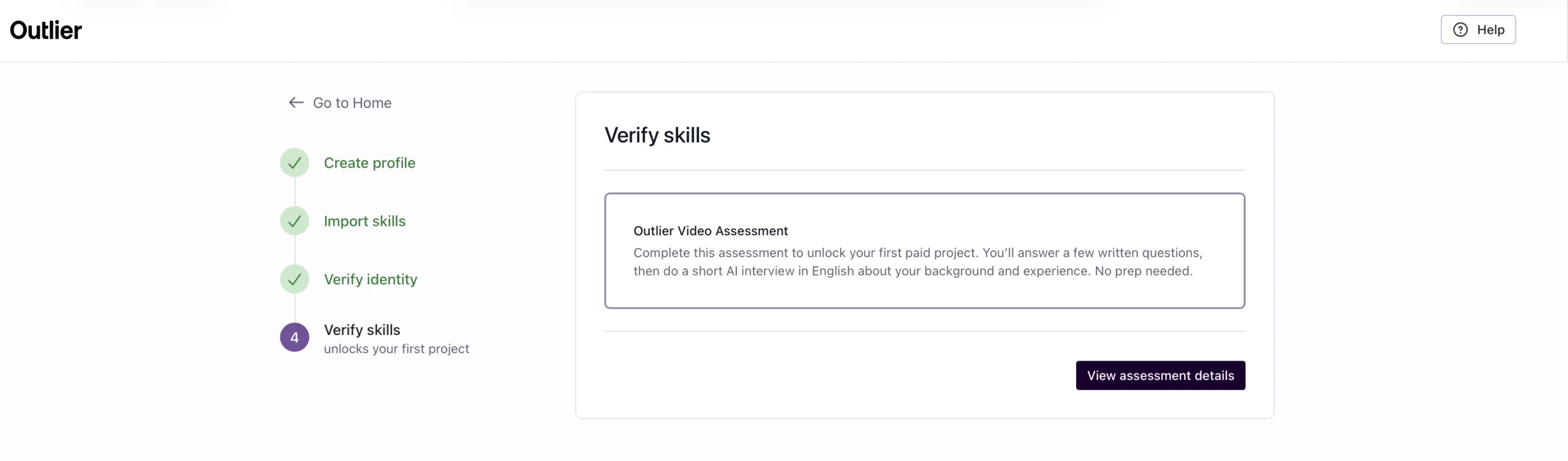
I applied to Outlier’s Video Production Experts listing, which pays for filming and editing short multi-camera clips for AI training. No question in my interview was about cameras, filming or editing. These were my seven questions, in order:
- a written task: list the differences between two descriptions of one video clip
- my current work and a typical day
- the languages I grew up speaking
- my education
- a time I compared two options and convinced someone
- a task to judge which of two videos follows a prompt
- a task to find the mistakes in a text message
Your interview can have other questions.
How to spot people who pretend to be Outlier
Before the interview, Outlier asks for your government ID and a selfie. Scammers pretend to be Outlier to get people’s ID, in messages and in videos: Outlier warns that many YouTube videos about onboarding for Aether, a group of Outlier projects whose onboarding includes this interview, come from scammers. The most useful check is to open app.outlier.ai yourself, sign in, and follow only the steps on your dashboard, the home page of your account, never steps from a message or a video. For the addresses that Outlier uses and the other signs of a fake message, read the full section in my article on whether Outlier AI is legit.
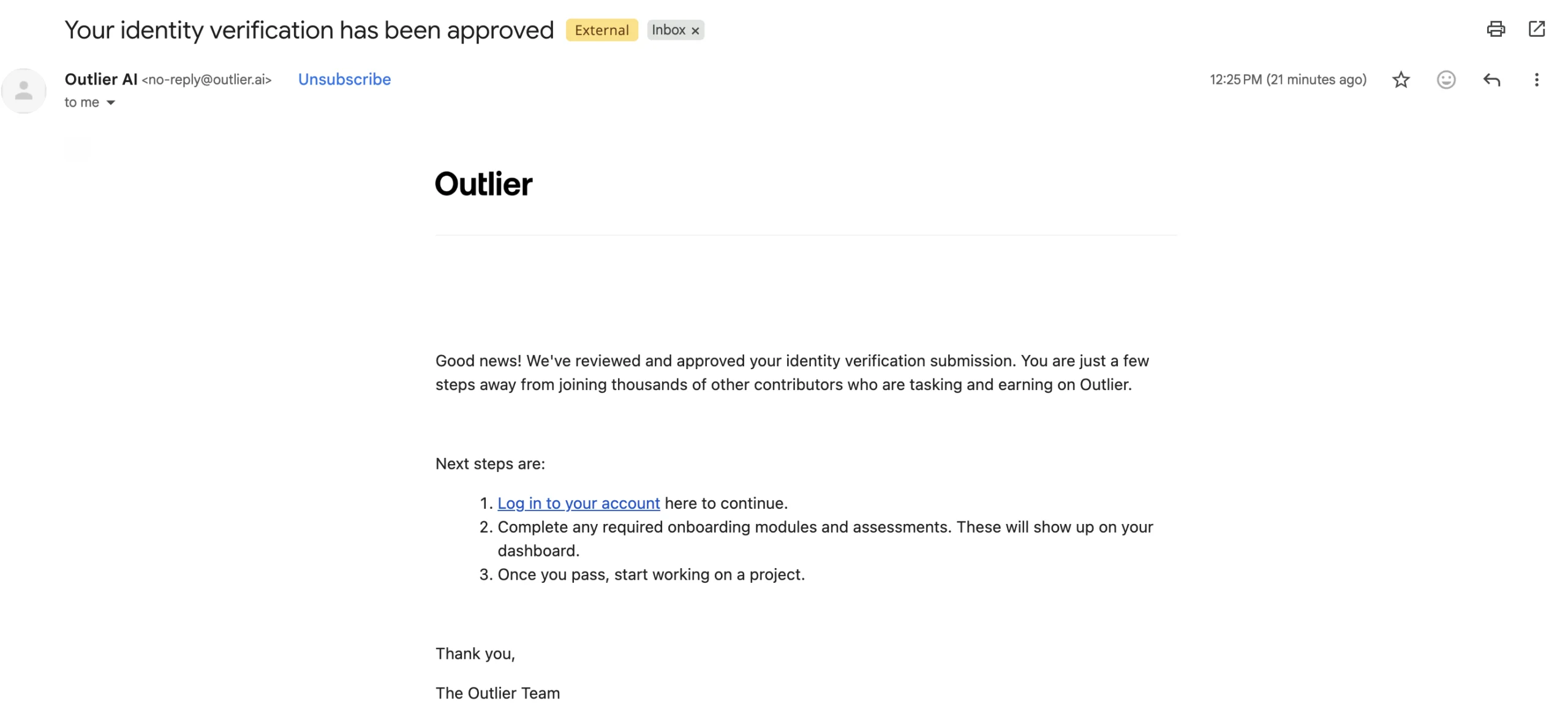
Set up your computer and room for the interview
You start the interview from your Outlier dashboard whenever you choose. Outlier’s onboarding FAQ lists what you need for it:
- A laptop or desktop computer. The interview does not work on phones or tablets.
- Google Chrome or Microsoft Edge. The interview works only in these two browsers.
- A working camera and microphone.
- Camera, microphone and screen-sharing permissions turned on in your browser.
- A quiet space and a stable internet connection.
- About 20 minutes in one sitting.
If the browser does not ask for the permissions, click the lock icon in the address bar, set Camera and Microphone to Allow, and refresh the page. On a Mac, also open System Settings, then Privacy & Security, then Screen Recording, and add Chrome or Edge to the list.
If the browser blocks the screen share, choose your full screen instead of a tab. If you have more than one screen, share the one where the interview is open.
I did not want to take the interview on my main work computer, so I used an old computer and created a new user profile on that computer. If you also use a second computer or a new user profile, turn on the browser permissions there before the interview, because a new profile starts without them.
Test your microphone before you start, and close any other app that uses it. A candidate failed three recorded Outlier tests because another app on their Mac was using the microphone, so nothing was recorded. They had to wait a month for a retake, and passed after they fixed the microphone.
Start only when nothing will interrupt you for about 20 minutes and your connection is stable. One candidate lost the internet connection in the middle of the interview. The interview started again from the beginning, the camera turned off on the last question, the onboarding failed, and the dashboard showed “You’ve reached your daily time limit for this project.”
If the camera or the screen share still does not work, write to Outlier Support from your dashboard. Include your browser and its version, your operating system, the time of the problem, what you tried and a screenshot of your full screen.
What Outlier records, and the rules you must follow
Outlier says it uses the screen share to confirm that you are the person taking the interview, and that the share captures your screen only during the interview session.
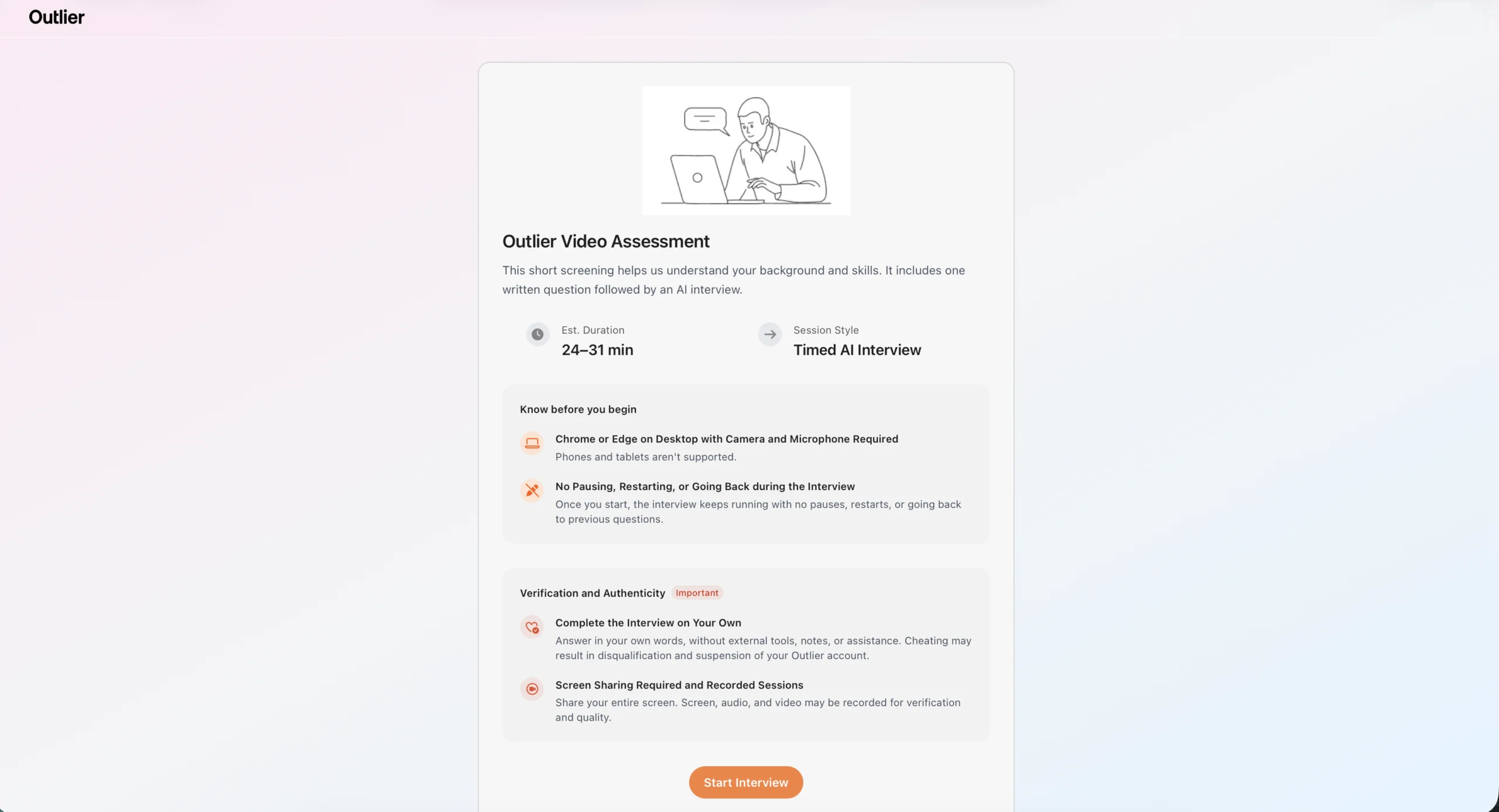
Outlier also says that only a small group of people at Scale AI, the US company that runs Outlier, can view the recording: people on its Trust & Safety, Security, Engineering and Legal teams. Outlier says it never sells the recording, shares it with clients or uses it to train AI models. It deletes the recording after seven days, or keeps it for up to 90 days if your account is under review for a rule violation.
Breaking these rules in the written task or in the interview can end in a fail or a closed account:
- No copy and paste, not even text from the same page. Outlier allows a notepad and Grammarly, but says never to copy and paste between an outside tool and your task. In r/outlier_ai, the Reddit forum of Outlier contributors, a reply to a deactivated candidate said the assessment forbids copying even the section titles from the same screen.
- No AI tools and no outside sources. The written task on my listing said “Use of external sources is strictly prohibited”, and “Submitting copied or artificially generated content” is one of the reasons Outlier gives when it deactivates accounts.
- Keep your face in view, and do not look away from the screen often or for long. The session is recorded and can be reviewed. You do not need to look at the camera all the time: contributors who never look straight at the camera report passing.
Outlier questions in my interview, and how I answered each one
1. The written task: list every real difference
The written task came first, on a screen titled “Answer the questions before your interview”. The screen said: “This short written step helps us understand your skills before the voice interview. It should take just a few minutes.” It showed “Question 1 of 1” and a timer of about 10 minutes. Below the answer box were the rules: “Please answer in your own words. Use of external sources is strictly prohibited. The timer will continue running if you leave this tab.” The bottom right corner of the screen showed “Screen monitoring active”. Outlier’s onboarding FAQ does not mention a written step, so your listing may not have one.
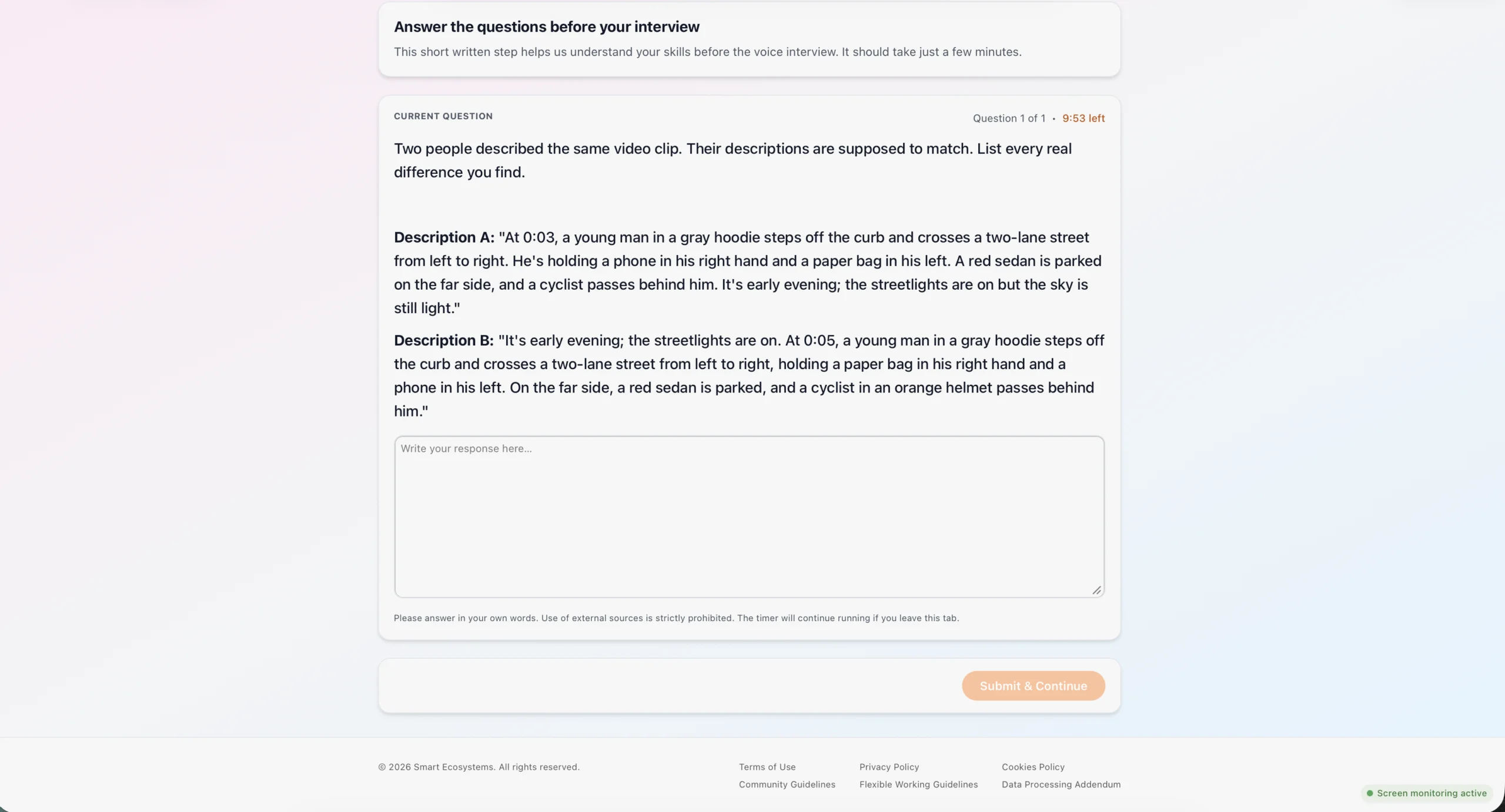
The task was:
“Two people described the same video clip. Their descriptions are supposed to match. List every real difference you find.”
Description A: “At 0:03, a young man in a gray hoodie steps off the curb and crosses a two-lane street from left to right. He’s holding a phone in his right hand and a paper bag in his left. A red sedan is parked on the far side, and a cyclist passes behind him. It’s early evening; the streetlights are on but the sky is still light.”
Description B: “It’s early evening; the streetlights are on. At 0:05, a young man in a gray hoodie steps off the curb and crosses a two-lane street from left to right, holding a paper bag in his right hand and a phone in his left. On the far side, a red sedan is parked, and a cyclist in an orange helmet passes behind him.”
What happened: this step had no interviewer, so there were no follow-up questions. The task is harder than “a few minutes” sounds. The contradictions are easy to see. The details that only one description gives are not, because you notice a missing fact only when you look for it in the other text.
Was my answer strong? Not really. I missed that only Description A says the sky is still light. My list also had the streetlights, although both descriptions say that they are on. I did not think that they were different: comparing the two texts on the screen was hard, so I was reusing lines inside my answer while I worked through them, and I forgot to delete the streetlight line. My lines also did not say which description said what: for the times, I wrote 0:03 and 0:05 without saying that 0:03 is from A and 0:05 is from B.
A stronger answer would list these four differences and nothing else:
- A says the man steps off the curb at 0:03, B says at 0:05.
- A says the phone is in his right hand and the bag in his left, B says the bag is in his right hand and the phone in his left.
- A says the sky is still light, B does not mention the sky.
- B says the cyclist wears an orange helmet, A does not mention a helmet.
The first two are contradictions. The last two are details that only one description gives, and they count because the two descriptions are supposed to match. Three facts are in both descriptions, only in a different place or in different words: “early evening”, the streetlights and the red sedan. The task asks for “real” differences, which means differences in facts, not in order or wording, so a stronger answer would not list them. Each line would also name the description that each fact comes from, as in the list above, so whoever grades the answer would not have to check both texts again.
2. Your current work and a typical day
The spoken interview opened with a question about my current work. Each question had a time limit, and the follow-ups on that question had to fit in the same limit.
What happened: I answered that I had built a system that helps me write articles. The interviewer asked what that system was, specifically, and “which platform tools or workflow” I used day to day. I said that the system runs on Claude and that it connects to outside tools to research YouTube videos, Reddit posts and forum articles. I did not describe the steps of my day, so the interviewer asked: “Can you walk me through a typical day’s workflow?” I answered that once the system is built, it does the work by itself, that my job had been to build it, and that my part now is to choose the input that goes into it, add directions and subject matter knowledge, and review and edit the result. The interviewer said “That’s helpful context”, then asked: “What did you personally do on a typical day? What was the first task you handled?” It also asked what my review and editing looked like “in concrete steps”. Only in my answer to that did I describe one real example of my own work, and then the time ran out: “Sorry, we’re out of time on this question. Let’s move on to the next topic.”
Was my answer strong? No, it was too general. To be honest, I felt a little uncomfortable describing exactly what I do each day, so I gave the answer that would probably have worked in an interview with a person. It does not work in an AI interview, because it does not fully answer what was asked. From the first follow-up on, the interviewer asked about my day-to-day work, and my next two answers described the system and my part in it only in general, not the steps of one day, so each one brought another follow-up. The one concrete example came only in my fourth answer, when the time for the question was almost over, and it was the same work that I had described before, only with more steps and details. The interviewer’s friendly “That’s helpful context” did not mean that my answer was enough.
A stronger answer would walk through one real task in order: what you did first, what you checked, what you changed and what the result was, with the tools you used for each step. For example, someone who does bookkeeping could say: “Yesterday I reconciled the month’s invoices. I exported them from the billing tool, matched each one against the bank statement, found two that were paid twice, and asked the supplier for a refund the same afternoon.” Given in the first answer, it would leave time for any follow-up.
3. Your language background
The interviewer asked two questions:
- “What languages did you grow up speaking with your family?”
- “Did you also speak English? … When and how did you learn it?”
What happened: I named my language, and said when and how I learned English. The interviewer asked nothing more and moved to the next topic.
Was my answer strong? Yes. It was short and factual, and it answered both questions. In my interview, this was the only question for which a direct answer with no example was enough.
4. Your education
The interviewer asked: “Tell me about your highest level of education. Where did you study? And what was that experience like?”
What happened: I named my university and my subject. The interviewer said “That’s a solid background” and asked: “What was a specific experience in your program that stood out? Maybe the most challenging class, a memorable assignment, or a project you worked on?” I answered that what I remembered most was that much of what I studied was of no use in a real job, although it still taught me how to learn. That was not one class or project, so the interviewer asked again for one specific class or project and what made it challenging or memorable.
I tried to get out of this question honestly. I said that I had studied 30 years ago and had no specific class or project in my memory. That was true: I could not recall any classwork from that time, and it was hard to come up with an example without making one up. The interviewer answered that it understood, and asked a third time: one course or topic, one concrete assignment or output I had produced, and what made it challenging. This last follow-up was narrower, because it named specific kinds of work, and one of them matched something I really remembered. Only then could I give a true answer. I described one such task and what was hard about it, and the interviewer moved on.
“What was that experience like” sounds like an invitation to talk about your studies in general, but the interviewer kept asking until it got one real example.
Was my answer strong? Only at the end. I gave a real example only in my answer to the third follow-up.
A stronger answer would say briefly that this was a long time ago and, in the same answer, describe the closest real assignment or project from your studies that you can still recall, and what made it hard. In my interview, “I do not remember” on its own only brought another follow-up. The example would not need to be a class or a big project, only something from your studies that really happened.
5. A time you compared two options and convinced someone
The interviewer asked: “What about a time you compared two options and had to convince someone of your pick? It can be anything from products to universities to Airbnbs. What were you looking at and how did you explain your thinking?”
What happened: the question asked about a time that really happened, but I understood it as a request to imagine a situation. I got distracted: the question gave Airbnbs as one example of what I might have compared, and because I had to choose an Airbnb recently, that example caught my attention so much that I misunderstood what the question asked. At the start of my answer, I said that I knew I was not answering the question the way it was meant, because in real life I do not do the convincing part in this situation. I then answered with my general way of choosing between the last few options, not with one real case. The interviewer said “Interesting approach” and asked for the case: “What were the two options you were comparing and who were you convincing? What was the situation? Did it involve a partner, a client, or a team decision?” I answered that there was no real situation, because I had understood that I should imagine one, and that this was the approach I use when I have to choose, so the person I convinced was myself. The interviewer said “Let’s stay on the current topic” and asked: “Are you saying the situation was hypothetical …? If so, could you describe what that reasoning looks like? What factors you considered or what you prioritized?” At that point I saw that I had probably misunderstood the question, and I took my answer back: it was not hypothetical, it was how I really decide, also when a friend and I look for a place to stay on a trip and are down to the last few options. In that case, I say that the small details no longer matter, and I let my friend take whichever option they prefer. There is no convincing. The last follow-up was: “Say they still weren’t convinced. What would you say to change their mind?” I asked what they were supposed to be unconvinced of. The interviewer repeated the same follow-up, I asked again, and the time ran out.
The last follow-up did not fit what I had said. Its words, “still weren’t convinced”, assume that I had argued for one option and that the other person had disagreed. Nothing like that had happened, so I had no point to make a second time. The interviewer asked it anyway, as if I had given the case that the question expected, one in which I argued for my choice.
Was my answer strong? No, it was wrong for this question. The question asked for a time when I convinced someone of my pick, and I described how I really decide: once I have narrowed many options down to the last few, I stop comparing small details and choose one at random, because each of them has pros and cons, and it is not a good use of my time to keep trying to find the “best” option. In three follow-ups, I never named two real options or one real time when I had to convince another person.
As with my answer about my work, this answer might have worked in a real interview with a person. It was honest: I said openly that my answer did not fit the question. It was a way of deciding that I really use, and it showed my personality and a clear opinion. For an AI interviewer, the same answer was completely wrong. The AI interviewer’s follow-ups show what it checked for: one real case with two named options, the person I had to convince, my reasons and what I would say if that person still disagreed. My answer gave reasons, but for my way of choosing, not for one real choice between two named options, so the follow-ups kept asking for the missing parts until the time ran out.
A stronger answer would be one case that really happened, with four parts: the two options, the person you had to convince, your reasons, and what you would say if they still disagreed. For example, someone who helped choose laptops for a team could say: “My colleague wanted the cheaper of two laptops for the team. I compared battery life and repair cost, showed her that the other one cost less over three years, and she agreed. If she had still disagreed, I was ready to offer a one-month trial of one laptop.” In my interview, the last follow-up asked what I would say if the other person still disagreed, so a stronger answer would have a second reason ready. The case could be small: two flats, two suppliers or two restaurants would all work, as long as it really happened and someone else had to agree.
6. Which video follows the prompt
The interviewer read this task aloud:
“Two videos are created in response to a prompt. They are both described below. Choose the one that better follows the prompt’s specific instructions and explain your choice.
Prompt: A golden retriever catches a red frisbee on the beach at sunset.
Video A looks great. Bright midday light, realistic beach. A golden retriever leaps for a red frisbee, catching it in its mouth.
Video B has a sunset that looks blurry in some frames, and the dog looks a little clunky. The golden retriever jumps and catches the red frisbee on the beach.”
What happened: I picked Video A. The interviewer asked why I chose it: “What specific aspects of the videos match the prompt’s requirements, especially the lighting, setting, and action?” That follow-up pointed at the lighting, the detail that decides the task. I answered with Video B’s flaws, the blurry sunset and the clunky dog, and the interviewer moved to the last task.
Was my answer strong? No. I judged the videos by how they looked, not by the prompt’s instructions, and when I gave my answer, I did not notice that Video A has no sunset.
The correct answer is Video B. The prompt has four instructions: a golden retriever, a red frisbee caught, a beach and sunset. Video A shows midday light, so it does not meet “at sunset”. Video B meets all four. Its blurry frames and clunky motion are quality problems, and the task asks which video “better follows the prompt’s specific instructions”, not which one looks better.
A stronger answer would say: “Video B, because the prompt asks for sunset and Video A is in midday light. B has blurry frames and clunky movement, which are quality issues, but it follows every instruction, and A misses one.”
The trap in this task is that the better-looking video is the one that does not follow the prompt. Video A is described first, and its description starts with “looks great” and “realistic”, while Video B’s starts with its flaws. If you judge on quality, you pick A. AI training work needs outputs that do what the prompt asked, so a stronger answer would judge each video by the instructions, not by how it looks.
7. Which mistakes are in the worker’s text message
The interviewer read this scenario aloud:
“A dentist asked the front desk to text a patient named Maria. The instructions say to tell her the appointment is Tuesday at 3, ask her to reply to confirm, and don’t mention the treatment. The worker wrote: ‘Hi Maria, a reminder about your root canal at 3. See you then.’ What did they get wrong?”
What happened: I answered that the worker did not ask Maria to reply to confirm and that the text mentions the treatment. The interviewer asked no follow-up and ended the interview.
Was my answer strong? Not really. I missed that the text leaves out the day, Tuesday.
A stronger answer would name all three errors in the worker’s text:
- The day is missing. The text says “at 3” but not “Tuesday”.
- The text does not ask her to reply to confirm.
- It mentions the treatment. “Root canal” is the treatment the instructions said not to name.
The time, 3, is correct, and “See you then” is not an error.
The missing day is the hardest error to catch, because nothing in the text points to it: you notice it only if you compare the text with each instruction one by one. As in the video task, a stronger answer would come from checking the text against every instruction, not only against the ones that stand out.
How my interview ended
After the last task, my interviewer said: “That concludes our interview. Thank you for walking me through your experience. Our team will review your session and you’ll hear back soon.” The interview ended there, with no result on the screen.
What happens after the interview
Your result appears as a status on your Outlier dashboard. The first status is not always the final one, so do these things after the interview:
- Check the notification icon on your dashboard. Results appear there, sometimes within 2 or 3 minutes.
- If the status stays “InProgress” for hours, wait. Contributors take a long “InProgress” status to mean a human review, and one result was still “InProgress” after 6 hours.
- Wait a day before you treat a fail as final, because some fails were reopened (report 2 below).
- After a pass, look for project onboarding and a screener on your dashboard. A screener is a graded test, and Outlier uses its result to decide whether you join the project. A pass does not always last (report 4 below).
I found no pass mark and no retake rule for the interview on Outlier’s pages. Candidates in r/outlier_ai report these outcomes after the interview or a screening:
- “Ineligible” seconds after finishing. A candidate did the whole video interview and saw a message that it would be reviewed. On the home page, the status was already “ineligible”, “literally seconds after I was finished”.
- Failed, reopened the next day, passed. A candidate failed on the first try, and says a person reviewed the attempt afterwards. The next day, Outlier wrote that the assessment had been reopened. The candidate completed it again in full and passed. Another candidate reports the same review and reopen.
- Passed on the first try, with tasks waiting. A contributor passed the AI interview on the first try and found at least 8 different tasks waiting on the dashboard.
- Passed, then removed the next day. A candidate passed the assessment, got an “Access unlocked to Aether!” email, and was removed from the project the next day. At least 6 other candidates replied that the same happened to them, one with an email that said “after careful review”.
- Deactivated after a first assessment. A candidate was deactivated during a first assessment that included an English AI video interview, before any paid work. The candidate says they sometimes looked away while thinking and may have copied and pasted text inside the written part. Replies said, “Copy paste is the trigger.”
- Questions with no time left, then deactivated. A candidate wrote that the interviewer asked questions “when there’s barely any time left” and then said, “Time’s up, next question”, twice. The candidate failed and was deactivated for “violating Community Guidelines”, Outlier’s conduct rules for contributors.
- A 30-day wait before reapplying. A candidate who had copied and pasted text into the answers to save time failed and had to wait 30 days before reapplying.
- Restricted, then reactivated. A contributor’s account was restricted for 3 days after a screening, then reactivated with an apology by email.
For deactivations, held pay and what Outlier’s contract allows, see my article on whether Outlier AI is legit.
If Outlier marks you ineligible and does not reopen your assessment, micro1 and Mercor hire for the same kind of AI-training work, also through an AI interview: my guides to the micro1 AI interview and the Mercor AI interview show how to prepare for theirs.
Outlier assessment questions in other tests before or after the interview
Depending on your skills and project, Outlier can give you these other tests, before or after the interview:
- Skill screenings. A skill screening is a short test of one skill. Outlier has skill screenings for generalist work, for coding languages and for languages, and uses the result to decide which projects you can join. A skill screening has written items, for example finding the bug in a piece of code or explaining what code does. Results usually arrive within minutes. After a fail, candidates report waiting about a month for a retake, and some skills cannot be retaken at all. Some skill screenings have also had recorded video items, with a timer at the top right of the screen that keeps running while you record. A candidate failed one by not noticing the timer.
- The Communication Assessment Screening. This screening includes video questions. Its fail email states: “We consider a score of 80% or higher on select questions to be passing”, and “we do not offer an opportunity to retake this assessment.” One candidate got this email after the screen had shown a green check.
- Project onboarding. If you move forward after the interview, the project has its own onboarding: a course, the project guidelines and graded practice tasks, then the screener. For Aether, where you describe images, compare items and rate AI voice conversations on a separate Aether platform, this includes the Aether course, a screening and setting up your Aether account. Reported times range from 45 minutes to 4 hours. My listing said that lower pay rates apply during initial project onboarding.
- Re-screening of existing workers. Contributors already on a project can get a new interview screener on their dashboard. A US Aether contributor on $15 an hour took one and lost access to the project 8 hours later.
Before each of these tests, read the instructions on the screen and watch the timer, because it keeps running.
Checklist for the Outlier AI video interview
Check points 1 to 6 before and during the interview, and point 7 after it. Each point is explained earlier in this article:
- No copy and paste anywhere in the session, including text from the same page.
- No AI tools or outside sources, unless a task says you may.
- Test the microphone, camera and screen share before you click start.
- Put your main point and your example in your first answer.
- Answer the exact question with one specific example.
- Take the interview in one sitting on a stable connection.
- After a fail, check the dashboard notifications and wait a day.
Before you sign up, read my article on whether Outlier AI is legit, which covers pay, account closures and the contract. If you decide to go ahead, sign up and apply on Outlier.